
Downing Depot Museum News
PROTECTED CONTENT
If you’re a current subscriber, log in below. If you would like to subscribe, please click the subscribe tab above.
Username and Password Help
Please enter your email and we will send you a password reset link.
Submitted by Judy Sharp
It’s June 2022 already. Time, life, community, history, moves right along, whether we’re paying attention or not. When I moved “back home” to northeast Missouri, I intended to spend time and energy paying respects to and investigating the history of my local ancestors. My life had been lived steeped in family history when I spent summers here and the other seasons in California. Wherever I was my family’s history followed along, but I experienced jobs, friends, and environments in other cities that I couldn’t have experienced here.
My early ancestors, and probably yours, chose for various reason(s) to move west to this unpopulated territory of what has become towns in Scotland and Schuyler counties. Mine chose Downing. So by learning about Downing and other transplanted families, I hoped to expand my knowledge and understanding of previous generations—how their experiences and aspirations developed into today’s values and ambitions.
After my local family passed on, I realized that I could help foster and promote the narrative of our area’s ancestors by contributing time and effort at the Downing Museum. It was time for my life to change a bit, somewhat like an “empty nest syndrome.” Even retired I can find plenty I enjoy doing, but I also find satisfaction helping maintain and work with Downing’s past.
A few things have caused me to write today:
• Unfortunately, I’ve not spent much time or energy toward the Downing Depot Museum this spring, in part because I had health responsibilities elsewhere (my apologies). Knowing the Museum hasn’t been used much I feel some responsibility for loss of our history. Myself, I have no children or grandchildren, but I want yours to have access to the previous ways, tools, and history of our forefathers and foremothers.
• While visiting various rural cemeteries on Decoration Day weekend, you may have noticed headstones fallen over, or come apart. Around here vandalism is seldom the cause, it’s the freezing and thawing and the many years they’ve stood. Traditionally the family cared for their own stones, but as families move away, a voluntary cemetery board usually steps up to hire lawn mowing and repair of stones from cemetery donations. Each year donations are dwindling for these cemeteries. Some boards have a volunteer at the cemetery gate to encourage and accept donations during Memorial weekend. Often visitors just pass them by. If you live near a cemetery where your family members are buried, please donate to the cemetery and consider volunteering for the board—they will appreciate your knowledge and help in decision making.
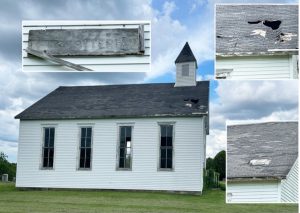
• We saw the large hole in the roof of the Cumberland Presbyterian Church building that stands on Campground Cemetery land. The other side is not much better. Do you realize that this church is not in any way connected to the cemetery, and there is no separate governing board? The Cumberland Presbyterian Church is still a denomination, but not in our area. I am distressed that we, our community, must watch as this part of our history goes to ruin; but maybe like me, you were unaware of the problem until now. According to the Anders’ on the cemetery board, the building is past repair. Though it’s located in Scotland County with a Memphis address now, Campground has long been associated with Downing. Please, please contact me if you are willing to discuss and tackle the dissolution of this church building and its contents before they are too damaged
• While I’m on rural cemeteries, it’s important to note that all burial locations are covered by laws: stones must not be moved or removed from their original location, livestock are not to be allowed to graze the area, and agriculture crops are not to be grown. These are sacred places and meant to remain as such.
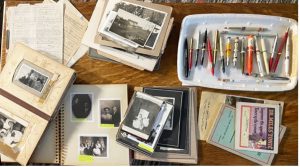
• Betty Duncan and I had a nice visit about the donation she was making to the Depot Museum: a large collection of family pictures (from the Downing families of Blodgett, Figge, Goosey, and Minium, and some connected families from Linn and Knox counties); additional WWII service papers of her father’s (Oren Blodgett) that we’ll add to his binder; and three old advertising cookbooks from Downing that her daughter had gifted her. She also gave us Bob Duncan’s collection of advertising pencils and pens from other local businesses. Bob was Betty’s brother-in-law and ran a restaurant in Downing. Her family has approved this donation to the Depot Museum.
• Sometimes I think about items on display that show personalities of Downing residents, barbershop implements, advertising pens and bottle openers, your grandad’s homemade stool, kitchen tools your mother loved, a sample of your parents’ wedding dishes, a favorite salt dish, a tool your uncle made to help with his farming. These are what Downing history includes.
• Meeting with Sandra Swindler Redding to visit about Lancaster’s and Downing’s early influences for preserving their histories and considering how to find individuals who are willing to help tackle the task of safe keeping all area history. I picked up a few binders from the Museum. She agreed to help me search the details about early Appreciation Days.
• I’m very aware of searching online for historical information that can’t be found yet knowing that the information is on old papers stored in our Depot Museum, or another area’s museum. At the same time, I realize that many people of all ages depend on computers for access to just about everything. Many people fail to comprehend that much digital information is lacking, and they are surprised that it requires hands-on volunteers to help recording, organizing, and promoting in order that historical information is maintained somewhere, even in museums, and old papers do disintegrate over time.
For an individual appointment to access the Downing Depot Museum collections, to donate anything, to volunteer your help, or for information about the Museum, call Jerry or Margaret Scurlock, 660-379-2467, Carol or Don Scurlock, 641-929-3915, or Judy Sharp, 660-342-1454. We’ll see you at the Depot.
Related Posts
Sigler Square Letter to the Editor
Screaming Sheila
Commission Minutes
