“That’s powerful. That’s America.”
The Inside Story About One Northeast Missouri Man’s Journey to Become a U.S. Citizen
By Echo Menges
For those of us born into it, citizenship is often something we don’t think much about. We grow up with a passport, the right to vote, the ability to work and live freely — and rarely question whether that will ever change.
But for Javi Gil, 51, of rural Rutledge, none of those things were guaranteed. Not even after spending decades in the United States, raising a family, leading a fire department, and dedicating his life to public service.
When delays in renewing his green card collided with sweeping immigration crackdowns in 2025, everything he had built in the U.S. — his home, his work, his safety — was suddenly at risk. His only path forward was a process many take for granted — becoming a citizen.
Coming to the United States
Javi Gil was born in Madrid, Spain, in 1974 to Carlos Gil and Inma Buendia. He grew up mainly in Spain, attending public school alongside his brother Carlos and sister Cova before attending college in Spain.
Javi also spent two years mostly living in Norway during his youth, which is where he learned to speak Norwegian. He also learned to speak English in his native country, not knowing he would end up in the United States.
He is fluent in Spanish, Norwegian and English.
“I can get by and understand some others, Portuguese, Italian, French, Swedish, and Japanese,” said Javi.
A world traveler, Javi had the opportunity to practice new languages during his travels.
In 1995, at just 20 years old, a life-altering encounter occurred when he met his future wife, Christina Lovdal, the day she arrived in Spain as a foreign exchange student.
The young couple became immediately inseparable during Christina’s time in Spain, and the two fostered a long-distance relationship for several years, taking trips between countries to see each other.
“I traveled as a tourist to the U.S. to visit,” said Javi. “We lived in Spain for a year, and Christina taught English there. Then, I applied to the U.S. government for us to get married.”
Javi and Christina married in 2000 in Concord, Massachusetts. While living in Massachusetts, Javi earned a degree as a court interpreter from the University of Massachusetts. He also obtained an associate degree in horticulture and opened his own organic lawn care business.
After arriving and getting married, Javi applied for a green card to legally work in the U.S., which was required to be renewed at least every ten years.
“I had to start from zero,” said Javi about his post-secondary education. “I worked at a golf course to learn about lawn care. I worked as a tree climber to learn tree care. I also worked at an organic farm to learn how to grow food.”
The couple eventually moved to New Hampshire, where Christina gave birth to their two children, Emma, now 18, and Max, now 16.
In 2013, Javi became a firefighter in New Hampshire.
In 2016, the family relocated to northeast Missouri, taking up residence in rural Rutledge and joining the community at the Dancing Rabbit Ecovillage, fully embracing their dream of living an off-grid sustainable lifestyle.
After arriving, Javi joined the Rutledge Volunteer Fire Department, sharing his skills with local volunteer firefighters. He became a wildland firefighter in 2018, which took him all over the U.S. fighting fires in Oregon, Washington, California, Arizona, New Mexico, Idaho, and Montana seasonally on a contracted crew.
Continuing his firefighting career, Javi became an engine boss in 2021, leading his wildland team. That same year, he accepted the fire chief position of the Rutledge Volunteer Fire Department. In 2023, he became a helicopter crew member, which taught him the logistics and skills of wildland firefighting from the air.
Also in 2023, Javi trained to be a dispatcher at the Scotland County Sheriff’s Office, helping out when needed and making himself available when his fellow dispatchers took time off. The role helped him understand the local dispatching process, systems and equipment. The experience added to and benefited his knowledge base as a firefighter.
Javi is arguably one of the most well-trained firefighters living in northeast Missouri, openly sharing his knowledge with the emergency response community throughout the region, continuing his training, and encouraging training opportunities for local volunteer firefighters.
Seeking U.S. Citizenship
In June 2025, a perfect storm of events pushed Javi to seek U.S. citizenship.
Less than one month after the federal government began a push for undocumented immigrants to self-deport, and images of U.S. Immigration and Customs Enforcement agents detaining immigrants spread across the country via national news and social media outlets, Javi hit a hiccup during a routine green card renewal.
He was notified his green card paperwork would take 22 months to process — much longer than ever before. The processing time put Javi in a bind. He knew his case wouldn’t be considered until long after his green card was set to expire — just five months later.
Those circumstances marked the beginning of an arduous process to consider a self-deportation plan and possibly being forced to go back to his native country after spending more than half of his life living in the U.S.
“I’ll just go back. I won’t risk being picked up,” Javi said right after receiving the notification in June 2025.
Javi began the process of obtaining U.S. citizenship and decided to seek legal counsel after starting the paperwork.
“I started doing all of the paperwork myself but it was overwhelming, and I didn’t want to take the risk of being disqualified for something I could have missed,” said Javi.
Javi contacted an attorney who specializes in immigration matters, Stephen T. Blower, Esq., based in Columbia, Missouri, to try to remain in the community and alongside his family — a process he admits he wished he would have started sooner.
“I believe people can apply for citizenship three years after being married, or five years living in the U.S.,” said Javi.
Blower took Javi’s case right away.
“I explained my situation about my green card getting close to expire in five months, and that the response from the government was that my case would be reviewed and decided within 22 months,” said Javi.
Javi’s family, friends and fellow emergency responders began to worry as images of immigrants being detained, deported and imprisoned washed across the country. Protests were popping up around the country, including in Missouri, and tensions further increased.
Javi kept his wits about himself and made responsible decisions for his roles in the community he served. He began to make arrangements to step down as a local fire chief — choosing to prepare the department for his possible departure, refusing to leave loose ends for the community to tie up without him, while still working toward his citizenship.
Not long after, his lawyer gave him the good news that he was granted a temporary two-year extension on his green card while his paperwork was processed, which allowed him to continue to work and travel. His green card was no longer in danger of expiring before he could complete the process.
Javi flew through the process.
“The naturalization process seems like it took just a few months. From the time we submitted the application, it took approximately one month to receive notice of my interview. Then, around a month-and-a-half later, the Oath of Allegiance happened,” said Javi.
In November 2025, Javi traveled to St. Louis for the U.S. Citizenship and Immigration Services in-person naturalization interview. He was also tested on his ability to speak, read and write basic English, and on his knowledge of the U.S. government and history.
Javi and Christina didn’t know what to expect going into the interview and test. Reports of immigrants being detained and arrested outside of immigration hearings were being spread far and wide. He was assured by his lawyer the process would be a smooth one — and it was.
Javi completed the interview and passed the test without any trouble, and the couple didn’t have any interactions with ICE agents during their trip to St. Louis. His interview and test were administered at the Robert A. Young Federal Building, just across the street from the federal courthouse.
“Things I had in my favor I think are that I didn’t have any arrests or warrants. No traffic tickets. No late payments, or anything that could flag me as a risk for society. I think that also living a life of service to others helped, as well as having an FBI file done back when I worked for the sheriff’s office. In my interview, they already knew all of that. They knew about all of my trips, all my life, even things nobody really knows — like a digital footprint,” said Javi.

Javier Gil walks toward the courthouse on the morning of his naturalization ceremony, adjusting the only suit jacket he owns. Just steps away from becoming a U.S. citizen, he carries decades of hope, sacrifice, and quiet determination on his shoulders. Photo by Echo Menges
The Tension
Tension around immigration continued to rise nationally, and in Missouri, the weeks before Javi was scheduled to attend his naturalization ceremony and take his Oath of Allegiance to the United States.
Controversy surrounding an ICE agent shooting a woman during an interaction in Minneapolis, Minnesota, reached a fever pitch.
Just days before Javi’s ceremony was to be held, protests in Kansas City were beginning to be reported, and Javi’s loved ones monitored the chaos closely – hoping it wouldn’t derail Javi’s final step in the process of becoming a U.S. citizen, and worrying about reports of immigrants being detained.
Javi traveled to St. Louis the day before the ceremony, to avoid any possible mishaps. He was joined by two of his friends and neighbors, along with this reporter – to document the trip and milestone.

Javier Gil, right, walks to the courthouse with friends and neighbors Alline Anderson and Kurt Kessner ahead of his naturalization ceremony in St. Louis on Jan. 16, 2026. The group traveled together from northeast Missouri to mark the milestone. Photo by Echo Menges
On Friday morning, Jan. 16, Javi was accompanied by his wife and daughter, and a handful of friends and neighbors, to the Thomas F. Eagleton Federal Courthouse in St. Louis for his naturalization ceremony. Javi and company entered the courthouse without any complications. ICE agents were not present, nor were any protests seen outside any of the federal buildings along the way.

Javier Gil, left, sits with his daughter, Emma, and wife, Christina, in the courtroom ahead of his naturalization ceremony at the Thomas F. Eagleton U.S. Courthouse in St. Louis on Jan. 16, 2026. Gil became a U.S. citizen after more than 20 years of residency. Photo by Echo Menges
The Ceremony
After entering the courthouse and being directed to the third-floor courtroom, Javi and dozens of other immigrants were given instructions about participating in one final interview before the ceremony would begin. Families and friends of the immigrants were welcomed into the courtroom to wait for the interview process to be completed.
The court staff cheerfully congratulated the soon-to-be citizens and warmly welcomed everyone present.
The tone inside the courthouse was in stark contrast to the tension felt before entering. Courthouse staff, including security personnel, brought the magic of the moment to life — welcoming and congratulating everyone preparing to take the oath.
Their excitement was contagious. They acted as a unifying force, easing the tension and reinforcing the significance of the occasion.
Nikeisha Fortenberry-White, U.S. Eastern District of Missouri deputy clerk — a woman small in stature but mighty in presence — ushered in friends and families and directed the commotion of organizing everyone into their seats ahead of the ceremony.

Nikeisha Fortenberry-White, deputy clerk for the U.S. District Court in the Eastern District of Missouri, welcomes families and guides participants through the naturalization ceremony process at the Thomas F. Eagleton U.S. Courthouse in St. Louis on Jan. 16, 2026. Photo by Echo Menges
“Come on in. Let me help you find your seat,” she said with a smile, congratulating every immigrant as they finished their final interviews and entered the courtroom.
Nauman Wadalawala, assistant U.S. attorney and naturalization examiner, also welcomed everyone to the courtroom with a friendly smile and a helpful attitude.
Javi’s final interview lasted less than two minutes and took place just outside the third-floor courtroom door. He turned in his green card, showed his identification, answered a few questions and signed his final citizenship document.
Once all final interviews were completed, Fortenberry-White announced that court was in session and introduced the Honorable Henry E. Autrey, U.S. District Judge in the Eastern District of Missouri, presiding.
Judge Autrey also warmly welcomed everyone.

U.S. District Judge Henry E. Autrey welcomes everyone to the courtroom during a naturalization ceremony in St. Louis on Friday, Jan. 16, 2026. Photo by Echo Menges
“Welcome to the United States District Court of the Eastern District of Missouri on such a significant, auspicious and beautiful day,” said U.S. District Judge Henry E. Autrey. “And I say beautiful — I know it’s cloudy and cold. But it’s not about what it looks like outside. It’s what we’re doing here today that makes today so beautiful. It’s sunny; the birds are chirping, the grass is green, the trees are blooming — and it’s all blooming for each and every one of you who is here to become citizens of the United States, to become members of one of the most significant, most fantastic, most longstanding, enduring and free — the freest — nation and family on this planet.”
After Judge Autrey welcomed everyone to the proceeding, he introduced the Courthouse Singers, who sang “America the Beautiful,” before Wadalawala introduced himself and motioned the court.
“Thank you, Your Honor, and good morning, everyone — and congratulations on this wonderful achievement and accomplishment,” said Assistant U.S. Attorney Nauman Wadalawala, who also serves as a naturalization examiner. “I sincerely congratulate each and every one of you. I say this often, but each time I preside over a ceremony like this, I get chills. I was in your place once. And I think about my parents, who were naturalized about 45 years ago — not in this building, but sitting in the same seats you are today.”
“This ceremony is even more significant because of your background, your heritage and your being here today. Mr. Wadalawala, may I indulge myself and have you say a few more words?” Judge Autrey asked.
“You know I can’t say no to an invitation like that,” Wadalawala replied with a smile. “It would be my honor.”
He shared how his parents emigrated from Karachi, Pakistan, to St. Louis roughly 45 years ago — a journey that began when his uncle moved to California to study engineering at the University of California, Berkeley.

Assistant U.S. Attorney Nauman Wadalawala speaks during a naturalization ceremony at the Thomas F. Eagleton U.S. Courthouse in St. Louis on Jan. 16, 2026. Wadalawala shared the story of his parents’ immigration journey from Pakistan and his grandmother’s efforts to pass the citizenship exam, calling the United States “the land of endless opportunity.” Photo by Echo Menges
“After getting his degree, he applied for a position and ended up in St. Louis,” Wadalawala said. “When he got here, he called his younger brother — my father — and said, ‘Hey, there’s this neat little town in America called St. Louis. Come over.’”
“So my parents took that bold step and made their way to New England and eventually to St. Louis,” he continued. “It was a huge culture shock. Back then, there was no technology like today, no South Asian stores. My parents had to buy calling cards from local shops to speak with family back home — and even then, they could only afford to call about once a month. Sometimes the call would cut off, and they’d just wait until next month to talk again.”
Wadalawala also reflected on his grandmother’s effort to pass the naturalization exam.
“It’s not an easy test, especially when English isn’t your first language,” he said. “I helped her study by pointing at the American flag and saying, ‘Red, white, blue,’ or by telling her, ‘If they ask who the president is, just say Bush.’ And she passed.”
He closed with a message about perseverance, opportunity and gratitude.
“Despite what you may hear, despite the negativity, the United States is still the best country in the world. It’s the freest country, and the land of endless opportunity,” he said. “When my parents came here 45 years ago, they could have never imagined that one day their son would stand in court and say the words, ‘My name is Nauman Wadalawala, and I represent the United States.’ That’s powerful. That’s America. And that’s what makes today so meaningful.”
He continued, “May it please the court, on behalf of the United States Citizenship and Immigration Services and in accordance with the Immigration and Naturalization Act, it is my privilege to present for your consideration 57 petitioners for naturalization representing 28 countries. Each petitioner has shown to the satisfaction of the Secretary of Homeland Security that they have met the residency requirements, are persons of good moral character, are attached to the principles of the Constitution and are well disposed to the good order and happiness of the United States.”
“On the basis of our interviews and investigations,” he added, “I move that you accept them to take the Oath of Allegiance and grant them United States citizenship.”
“Thank you, Mr. Wadalawala,” Judge Autrey responded. “Is there anyone who objects to the motion regarding the admission of these 57 petitioners as citizens of the United States?”
After a pause, he continued, “Seeing no hands and hearing no voices of opposition, the motion is granted.”
Javi and his counterparts stood holding up their right hands and took the oath, repeating aloud, “I hereby declare, on oath, that I absolutely and entirely renounce and abjure all allegiance and fidelity to any foreign prince, potentate, state, or sovereignty, of whom or which I have heretofore been a subject or citizen; that I will support and defend the Constitution and laws of the United States of America against all enemies, foreign and domestic; that I will bear true faith and allegiance to the same; that I will bear arms on behalf of the United States when required by the law; that I will perform noncombatant service in the Armed Forces of the United States when required by the law; that I will perform work of national importance under civilian direction when required by the law; and that I take this obligation freely, without any mental reservation or purpose of evasion — so help me God.”

Javier Gil raises his right hand while taking the Oath of Allegiance
during a naturalization ceremony at the Thomas F. Eagleton U.S.
Courthouse in St. Louis on Jan. 16, 2026. Gil, originally from Spain, became a U.S. citizen after living in the country for more than two decades. Photo by Echo Menges
After the oath was taken, the group recited the Pledge of Allegiance as citizens of the United States.
Each new citizen was then recognized individually, standing when their name was called by Wadalawala. It served as a moving tribute for the effort that brought the group together.
The Courthouse Singers followed with the National Anthem, as they were joined by many more voices in the courtroom.

The Courthouse Singers perform during a naturalization ceremony at the Thomas F. Eagleton U.S. Courthouse in St. Louis on Jan. 16, 2026. The vocal group is a regular part of the district’s citizenship ceremonies. Photo by Echo Menges
Closing Moments
“I won’t be long,” said U.S. District Judge Henry E. Autrey, addressing the room of new citizens. “But I hope to share a few thoughts that will underscore the importance of today. I’m sure you already know it, but I feel compelled to highlight it — because that’s what judges do when we have an opportunity to speak.”
He went on to say, “You are becoming citizens of the freest and greatest country in the world — and I believe that with all my heart. You’re joining not just a nation, but a family. And it is that freedom and strength that I believe brought you here today.”

U.S. District Judge Henry E. Autrey addresses the courtroom during a naturalization ceremony in St. Louis. He spoke about the enduring strength of American democracy, the responsibility of citizenship, and the power of the vote — reminding new citizens that they were now part of “the freest nation and family on this planet.” Photo by Echo Menges
Judge Autrey reflected on the sacrifices made by immigrants.
“It’s not easy to leave behind your homes, your families, your friends — the life you knew — to come to a new place for opportunity,” he said. “But here, you gain the freedom to speak, to write, to travel. The freedom to educate and raise your children in a broader, more global way. The freedom to pursue your interests, to worship, to work, to own property — to build a legacy for your children and grandchildren.”
“That legacy is one of freedom. One of hope. One of striving for something greater. As perfect as this country may be in its ideals, it can always become more perfect — and you are now part of that effort.”
He spoke about the rule of law as the foundation of American citizenship.
“What you did here today — taking the oath — is an expression of that rule of law. It’s what allows a courtroom like this to even exist,” he said. “The Founding Fathers understood that. They built it into the Constitution — the very document that breathes life into the freedoms we enjoy each day. But those freedoms are not free. They require work. They require vigilance.”
Judge Autrey emphasized that citizenship involves responsibility.
“We have to be aware of what’s going on in our neighborhoods, our cities, our states and our nation,” he said. “And one of the most important ways to uphold that responsibility is to vote.”
He addressed skepticism new citizens may encounter.
“You may hear people say, ‘Well, they’re going to do whatever they want anyway. We don’t have any power.’ That is a psychological lie,” Autrey said. “The power doesn’t come from the top. It comes from the people — the grassroots, the citizens of the United States of America. That’s what our Constitution means.”
He warned that the only way we lose that power is if we give it away.
“If we do that, there is no ceremony like this. There is no hope. There is no justice system where we settle disputes peacefully and fairly in a court of law.”
His voice remained firm but encouraging.
“So be vigilant. Do your job as citizens. Stay informed. Participate,” he said. “Those elected officials — they represent us because we voted. They exist only because we allow them to through our voice.”
With a smile, he added, “Now, I could talk about this for two or three days — and I still wouldn’t run out of things to say,” he said. “But that’s not your purpose today. Maybe someday I’ll write it all down and you’ll read it and say, ‘I’m glad I showed up that day.’”
He closed on a warm and celebratory note.
“Thank you for being here. It is my honor to be your judge today and to welcome you into the family of American citizens,” Autrey said. “After this, you’ll receive your certificates of citizenship. And outside, there are people available to help you register to vote. Nobody will force you — that’s not how we operate here. But I urge you, take the opportunity. It’s right there.”
“Once you register, you’re ready to vote in any and all elections in your jurisdiction. Again, thank you, and on behalf of my fellow judges in the Eastern District of Missouri, the state of Missouri and the United States of America — welcome.”

From left: Assistant U.S. Attorney Nauman Wadalawala, U.S. District Judge Henry E. Autrey, and Deputy Clerk Nikeisha Fortenberry-White smile during a naturalization ceremony at the Thomas F. Eagleton U.S. Courthouse in St. Louis on Jan. 16, 2026. Photo by Echo Menges
Before leaving, each new citizen was called on to receive their citizenship certificate and invited to pose for a photo in the well of the courtroom alongside an American flag.
Javi and his family were joined by their friends and neighbors for the photo. Fortenberry-White and Wadalawala also graciously agreed to pose for the photo, further commemorating the occasion.

Javier Gil, second from right, poses with family, friends and supporters — including his wife, Christina; daughter, Emma; friends Kurt Kessner and Alline Anderson; Assistant U.S. Attorney Nauman Wadalawala; and Deputy Clerk Nikeisha Fortenberry-White — following his naturalization ceremony at the Thomas F. Eagleton U.S. Courthouse in St. Louis on Jan. 16, 2026.
When Javi left the courtroom, he took Judge Autrey’s advice. His first act as a citizen was to sit down with a volunteer from the League of Women Voters, who was stationed outside the courtroom — and he registered to vote.
According to U.S. Citizenship and Immigration Services, American citizens have a wide range of rights and responsibilities. They can vote, serve on juries, apply for federal jobs and scholarships, and bring family members to live in the United States. They can hold a U.S. passport, receive assistance overseas, run for federal public office, and access government benefits. Most importantly, they cannot be deported. A U.S. citizen’s right to remain in the country is permanent — and cannot be taken away.

Javier Gil stands outside the Thomas F. Eagleton U.S. Courthouse in St. Louis on Jan. 16, 2026, ahead of his naturalization ceremony. Originally from Spain, Gil became a U.S. citizen after more than two decades of living and working in the United States. Photo by Echo Menges

The Great Seal of the United States above the courthouse entrance — a symbol of the nation that 57 new citizens pledged allegiance to during the naturalization ceremony. Photo by Echo Menges
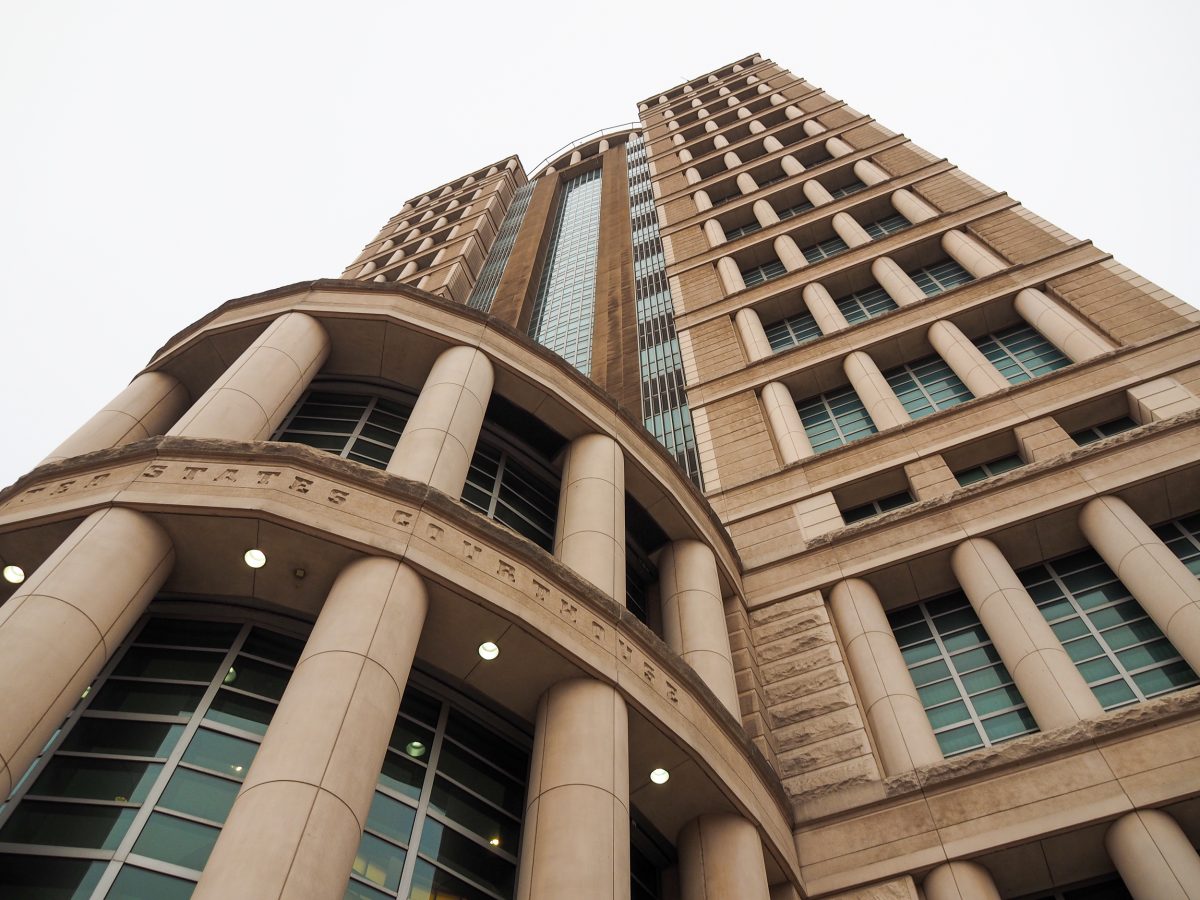
The Thomas F. Eagleton U.S. Courthouse in downtown St. Louis rises skyward — the setting where 57 immigrants, including Javier Gil, took the final step to become American citizens. Photo by Echo Menges