Memphis Breaks Ground on Hangar to House Rare Pheasant Plane
PROTECTED CONTENT
If you’re a current subscriber, log in below. If you would like to subscribe, please click the subscribe tab above.
Username and Password Help
Please enter your email and we will send you a password reset link.

MEMPHIS, Mo. — Nearly a century after Memphis briefly soared into aviation history, residents gathered Saturday to break ground on a permanent home for one of the town’s most unique legacies — a Pheasant H-10 biplane, designed and built in 1927 just blocks from where the ceremony was held.
On Saturday, the Scotland County Historical Society hosted the groundbreaking at the Downing House Museum Complex, 311 S. Main St., marking the next step in a community effort that began with a magazine ad and turned into a mission to bring the town’s plane home.
Among those participating in the ceremony were Peggy Brown, widow of the late Ronnie Brown — whose discovery of the aircraft for sale first sparked the project — along with Doc Wiggins, Lew Prather, Fred Clapp, Rodney Mulvania, Audrey Glass, Stanley Myers, and Dr. Harlo Donelson.
“It’s been a passion for so many for so long,” said Historical Society volunteer Julie Clapp, who emceed the event. “We’re bringing the Pheasant home.”
A Flying Start — and Sudden Loss
Incorporated on June 27, 1927, the Pheasant Aircraft Company was the vision of flight school operator Lee R. Briggs, who rallied the Memphis community to support an aircraft manufacturing venture. The company produced a three-seat biplane designed by Orville Hickman, with Harold Phillips as test pilot and Roy Moore serving as master mechanic.
The factory turned out planes at an impressive rate of one per week at its peak. But tragedy struck on December 5, 1927, when Briggs and student pilot Otis Oliver were killed in a crash. Despite the loss, production resumed in early 1928. In total, 36 aircraft were built before the company was moved to Wisconsin and later absorbed by Dayton Aero & Engineering in 1930.
Rediscovery and Return
The story might have ended there — if not for a discovery more than 80 years later.
In August 2011, Ronnie Brown came across a listing in Trade-A-Plane magazine for a Pheasant H-10 for sale on Long Island, New York. The price was $75,000.
Ronnie Brown wasn’t alone. A group of aviation enthusiasts and community leaders joined him to form the Pheasant Airplane Committee under the Scotland County Historical Society. The committee successfully raised the necessary funds — more than $80,000 in total — with help from citizens, local businesses, and organizations
Dr. Harlo Donelson, a Memphis dentist visiting New York at the time, volunteered to inspect the aircraft on site.
“She’s a beauty,” Donelson said of the vintage plane.
Doug Brown, Ronnie’s son, spoke during Saturday’s ceremony, sharing his dad’s excitement of of bringing the rare airplane home to Memphis. “Nothing compared to hauling it back from Long Island,” he said.
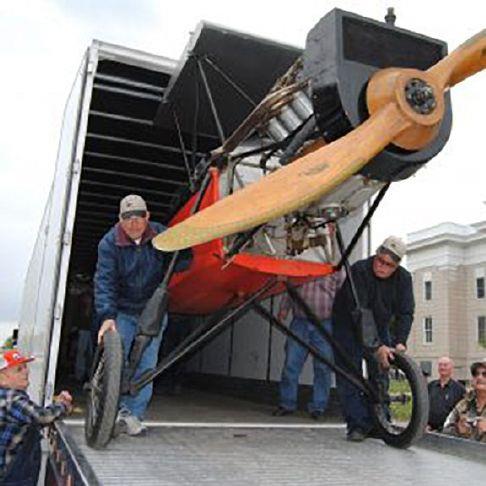
The recovery team included Ronnie Brown, Lew Prather, Stanley Myers, Fred Clapp, and Rodney Mulvania. In April 2012, they traveled to Long Island to retrieve aircraft, took turns taxiing it on the runway, then disassembled the aircraft.
As the semi-trailer arrived on the Memphis square, hundreds of area residents and aviation fans turned out to witness the Pheasant’s homecoming. The aircraft was then transported to the Wiggins Family Museum at Highway 136 and Knott Street, where it has been housed ever since.
A Rare Survivor
Only three known examples of the Pheasant H-10 still exist. One is displayed at the EAA AirVenture Museum in Wisconsin. Another resides in the Western Development Museum in Moose Jaw, Saskatchewan. The third — and the only one to return to its place of manufacture — is now in Memphis.
The new hangar will not only provide proper preservation of the aircraft but also serve as a public exhibition space, celebrating the city’s brief but ambitious contribution to early aviation.
With Saturday’s groundbreaking, the final piece of the story is being written.


Related Posts
Meet the Candidates Event to be Held July 24