AI for Small Business: Your New Intern Isn’t Human
By Ella Aguilar
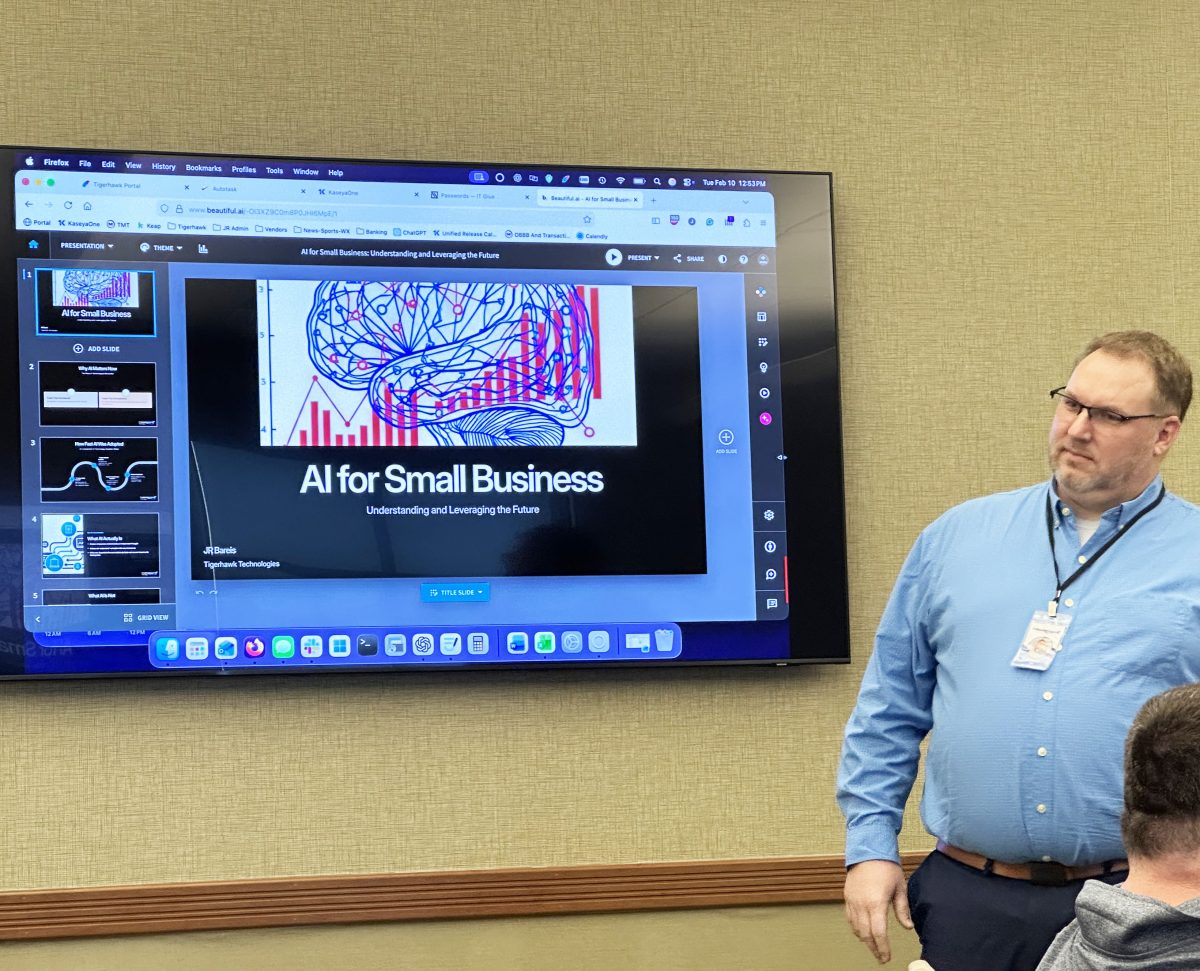
Artificial intelligence might sound like something built for Silicon Valley tech giants. Still, at this month’s Chamber of Commerce meeting,
JR Bareis of TigerHawk Technologies
made one thing clear: AI is already here, and small businesses cannot afford to ignore it.
To put the speed of change into perspective, Bareis opened with a comparison. It took the radio 38 years to reach 100 million users. Television reached that milestone in about 13 years. The internet did it in roughly 4 years. Smartphones? Around 2 years.
AI tools like ChatGPT reached 100 million users in just a matter of months.
The pace isn’t slowing down, and local businesses are going to feel it.
One of the most relatable moments of the presentation came when Bareis described AI not as artificial intelligence, but as an intern or assistant.
“It’s super fancy autocomplete,” he explained.
AI doesn’t think. It doesn’t create genuine human emotion or lived experience. It predicts patterns based on data. It feels smart because it can hold massive amounts of information and recall it instantly, but it’s not human.
Different people can ask the same question and receive three slightly different answers. That’s not personality, but probability.
When used correctly, though, it becomes powerful.
Bareis emphasized practical uses, not futuristic robots.
AI can help small businesses with:
– Drafting emails
– Writing social media captions
– Scheduling and planning
– Brainstorming ideas
– Organizing workflows
– Automating repetitive administrative tasks.
The Result?
Same people. More output.
Instead of replacing employees, AI can reduce repetitive work, allowing teams to focus on what actually grows a business: relationships, strategy, and customer experience.
Recent studies show that small businesses using AI-driven marketing tools can reduce content creation time by up to 50-70%. Customer service chatbots can handle up to 80% of routine questions. That does not eliminate staff; it frees them up for higher-value conversations.
In other words, AI competes with:
– Blank pages
– Slow processes
– Inefficient workflows
– Repetitive tasks
“Copy and paste is old,” Bareis noted. Instead, businesses can now create AI “agents” that handle recurring processes automatically.
Bareis didn’t ignore the elephant in the room.
AI will replace specific jobs, particularly those centered around repetitive or predictable tasks. But it will also make people more efficient and create demand for new skills.
History shows that every major technology shift does both. When ATMs were introduced, many predicted the end of bank tellers. Instead, the role evolved. The same pattern is unfolding with AI.
Businesses that adapt tend to benefit. Businesses that ignore major shifts often struggle.
While the opportunities are exciting, Bareis stressed caution.
1. Data Privacy
AI systems learn from data. In some platforms, conversations may be used to improve the system unless privacy settings are adjusted. Business owners should understand what information they are sharing and use appropriate safeguards.
2. Confidently Wrong Answers
AI can sound authoritative, even when it’s incorrect. It can generate inaccurate statistics, outdated information, or fabricated details. Everything necessary should be fact-checked.
3. Over-Trusting Automation
Relying too heavily on automation can create blind spots. Human oversight remains essential.
AI is an assistant, not a decision-maker.
One particular striking statistic Bareis shared: about 70% of people now accept Google’s AI-generated response instead of clicking through multiple links to research further. Just a few months ago, that number was closer to 50%
Consumers increasingly want instant answers.
This shift changes how businesses approach online visibility. Traditional SEO is evolving. It’s no longer just about ranking high in search results; it’s about being structured in a way that AI systems can reference and summarize your content.
Websites that provide clear, helpful, well-organized information are more likely to appear in AI-generated responses. That means clarity, authority, and strong digital presence matter more than ever.
For small business owners in our community, AI isn’t about replacing staff or becoming a tech expert overnight.
It’s about:
– Working smarter
– Reducing burnout
– Responding faster to customers
– Creating consistent marketing
– Gaining a competitive edge
AI won’t build relationships. It won’t shake hands at Chamber events. It won’t understand local nuance the way a human does.
But it can help free up time to do more of that work.
As Bareis framed it: AI isn’t your replacement.
It’s your intern.
And like any intern, it works best with supervision.