Voices and Votes: Democracy In Action Smithsonian Exhibit Opens, Invites Public To Heritage Tours
PROTECTED CONTENT
If you’re a current subscriber, log in below. If you would like to subscribe, please click the subscribe tab above.
Username and Password Help
Please enter your email and we will send you a password reset link.
Submitted by Shelia Berkowitz
“Heritage Tours: Where Every Stop Tells a Story” will be the Smithsonian Democracy in Action local event in conjunction with the “Voices and Votes: Democracy in America” exhibition for Saturday, September 20, 2025, from 1:00-4:00 p.m, and September 27, 2025 from 1:00-4:00 p.m. Visitors will be able to “Step into Scotland County’s past” with tours at iconic Memphis sites.
Sites included in the Heritage Tours will be the Downing House Museum Complex (Downing House, Boyer House, Summer Kitchen, Carriage House, old Memphis Depot, and the Pheasant Airplane future hangar site), the Pheasant Airplane Exhibit, the Log Cabin Courthouse and the Scotland County Courthouse, the Memphis Theatre, and the Scotland County R-1 Schools.
Visitors at the exhibit can pick up a commemorative tour map and passport booklet. They may collect a sticker at each site to “stamp” their passport – courtesy of Scotland County Memorial Library.
Batina Dodge, Economic Development Planner for the Northeast Missouri Regional Planning Commission, is the Site Manager for the event.
Downing House
The Downing House Museum Complex (311 S. Main Street in Memphis) includes the Downing House, Boyer House, Summer Kitchen, Carriage House, the old Memphis Depot, the Barnett Statue, and the Pheasant Airplane’s future hangar site.
Downing House
The Downing House is a 14-room brick museum, designed by Thomas Broadwater of Virginia. William G. Downing, whose family had come from Virginia, married Mary Jones, daughter of the first sheriff of Scotland County. During the Civil War Union Soldiers used the Downing House as Headquarters, and rode their horses in through the 10 foot doors.
On September 1, 1978, the Scotland County Historical Society purchased the property and have been continually restoring the house. Period furnishings have been donated to furnish many of the rooms including the Patterson Parlor, the Luther Library, and the Morgan Dining Room.
One of the favorite exhibits at the Downing House is the life size model of Ella Ewing, the Missouri Giantess. She was 8 feet 4 inches tall and weighed 277 pounds, and as a young woman, she was an attraction in the P.T. Barnum Circus. Other memorial rooms highlighting Scotland County’s history include a vintage barber shop, Civil War relics, early aviation history, and a music room.
Boyer House
In June 1987, the Keith and Ruth Ann Boyer Family donated the house just north, adjacent to the Downing House Museum. The house was a part of the Downing House at one time. The two-story frame building had been built onto the original Downing House when it was known as the Park Hotel. It was removed in 1907 and moved to its present location, which is now the Boyer House.
Memphis Depot
The old Memphis Depot was donated to the Scotland County Historical Society by the City of Memphis in 1987 and was moved in May 1988 from its original site near the corner of Huntington and Jackson Streets to the present location on the Downing House grounds, as part of the Museum Complex. The first train arrived in Memphis on September 28, 1871, and the railway line passed through Granger, Arbela, Memphis, and Crawford Stations.
Summer Kitchen
The Summer Kitchen was built in 2003 and contains artifacts of the 1850 era. Originally it would have been used by slaves for cooking and canning for the Downing Family. Summer kitchens were not attached to the original house due to the danger of fire and to keep the main house cooler in the summer.
Carriage House
The Carriage House is located between the Depot and the Summer Kitchen in the Downing House Complex, and is used to display artifacts originally found in carriage houses including tack, a horse cart, a sleigh, western saddle, blacksmith tools, and hand tools used in early American farming.
Barnett Statue
“The Soldier in the Field” statue, also known as the Barnett Statue, was donated to the Scotland County Historical Society by the Leland and Ruth Cantril Family. The historic World War I monument, which has information about Purnell Batts Barnett, was donated with the stipulation that it be moved to the Museum Complex.
“Every time I give a tour of the Downing House and the Complex, I see something new,” commented Museum Curator Rhonda McBee. She encourages the “Voices and Votes” visitors to take time to view the many exhibits and artifacts on display at the Downing House Museum Complex and to make plans to attend the “Evening at the Museum” event on October 10-11, 2025.
Pheasant Airplane Exhibit
The first Pheasant Airplane was a three-seater designed by Orville Hickman. Harold Phillips of Memphis was the test pilot, and Roy Moore of Lomax, Illinois, was master mechanic. Production peaked at one unit per week.
The Pheasant flight engine was developed in house for the H-10 Aircraft. In 1927, flight school operator Lee R. Briggs had mobilized Memphis, Missouri, community members to incorporate a company for aircraft production. The Pheasant Aircraft Company, an American aircraft manufacturer of Memphis, was incorporated under the laws of the state of Missouri, on June 27, 1927.
In August, 2011, Ronnie Brown of Memphis, Missouri, discovered an ad in the Trade-a-Plane Magazine advertising a Pheasant H-10 for sale on Long Island, New York. The recovery team of Ronnie Brown, Lew Prather, Stanley Myers, Fred Clapp, and Rodney Mulvania traveled to Long Island, New York, in April, 2012, to transport the Pleasant back to Memphis.
The Scotland County Historical Society hosted a ground breaking ceremony for the hanger to house the Pheasant Airplane on Saturday, August 23, 2025, at the Downing House Museum Complex site.
There are only three (3) Pheasant H-10’s known to exist: One in a museum in Wisconsin, one in a museum in Canada, and one in Memphis, home of the Pheasant Airplane. The Pheasant is currently housed in the Wiggins Family Museum (Highway 136 and Knott Street in Memphis).
The full story of the Pheasant Airplane and the groundbreaking ceremony were featured in the August 14th and 28th editions of the Memphis Democrat.
Log Cabin Courthouse
By an act of the general assembly approved January 29, 1841, part of Lewis County known as Benton Township was set apart as a separate county and was organized for civil and military purposes. Benton Township included the present territory of Scotland County, together with a strip of the northern part of Knox County. The county seat was in Sand Hill, and the first courthouse was a single room log cabin.
Carl Trueblook, local history enthusiast, noted that the building is over 175 years old. In 2016, Trueblood, Dr. Larry Wiggins, and other history lovers purchased the original courthouse, moved the cabin from the farm where it sat for many years, and began to refurbish the building. The structure is housed in the Wiggins Family Museum at East Monroe Street and South Market Street in Memphis,
Documents and court results entitled “Presentation: Scotland County Circuit Court at Sand Hill, 1841- 1844” compiled by the Honorable Judge Karl DeMarce, Associate Judge of the First Circuit Court of the State of Missouri are located at the Scotland County Memorial Library.
The second courthouse was a two story brick structure designed by Charles Mety and built in 1844 and 1845 at a cost of $1,500. The building was torn down in 1857.
The third courthouse was a two story brick and stone building designed and built in 1856 at a cost of $19,500. The building was razed in 1907.
The fourth and present courthouse was constructed in 1907 to 1908 at a cost of $50,000. The Scotland County Courthouse, located at 117 S. Market St., houses offices including the County Clerk, Assessor, Circuit Clerk, Collector of Revenue, Recorder of Deeds, Public Administrator, Prosecuting Attorney, Sheriff, Treasurer, and the Juvenile Office. The courthouse also contains the Circuit Courts Office, the Scotland County Extension Center, Presiding and Associate Commissioners Office, and the County Coroner’s Office.
Visitors are encouraged to visit these sites to see where history is and was made and where the “ever-evolving story of democracy and the principles of democracy through everyday civic life” is enacted says Batina Dodge.
Memphis Theatre
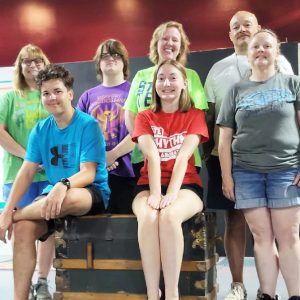
The Memphis Community Players, which was established in 1975, will continue its 50th anniversary celebration with an Open House on September 20 and 27, 2025, from 1:00-4:00 p.m. at the Memphis Theatre. The Open House will feature costumes, set vignettes, pictures, and programs/playbills from many of the MCP shows. There will also be tours of the theater’s facilities including “behind the scenes” of a production.
In August, 2025, the Players celebrated their 50th anniversary with the play “Clue: On Stage”, based on the 1985 movie “Clue,” which was inspired by the classic board game. The first production by the group was “The Fantasticks” in 1975. Including this summer’s production, the MPC have presented 49 shows – musicals, comedies, melodramas, Christmas shows, and musical revues – over the fifty years.
There were two extension groups from the Community Players, The Evening on Broadway Troupe and the Mark Twain Chorale International. The Evening on Broadway Troupe was formed to raise money to build the new Memphis Theatre after the Memphis Cinema burned in 1992. The group performed solos, ensembles, and choral arrangements of Broadway musicals woven together by a historical narration. The singers performed in Iowa, Missouri, and Illinois, and even performed in the Rotunda of the Missouri State Capitol Building in Jefferson City.
The EOB Troupe expanded to the Mark Twain Chorale International which has traveled to over fifteen European countries as musical ambassadors where they performed gospel, Broadway, big band, and contemporary music in world-famous venues, most notably St. Peter’s Basilica located in Vatican City.
In addition to producing musicals and comedy plays during the summer, the Community Players sponsors and shows movies, mentors the Scotland County R-1 Drama Club, sponsors Drama Camp each summer for student in grades three through twelve (at no cost to the students), and awards scholarships to SCR-1 graduates who have participated in summer productions. The Players also arrange for special movie showings for local and surrounding school groups.
October 10-11, 2025, the MCP will be working with the Historical Society and Downing House Museum directors to host a special presentation of “Evening at the Museum” in conjunction with the “Voices to Votes: Democracy in America” Smithsonian exhibit.
The Memphis Community Players aims to enrich local culture through performing arts for audiences of all ages. Joe Fulk, MCP President, shares the goals of the group, “Participating in fine arts offers numerous benefits: fostering creativity, enhancing academic performance, and promoting social-emotional development. These benefits extend beyond the classroom, contributing to well-rounded individuals prepared for future success, regardless of what career path they choose.”
Scotland County R-1 Schools
Scotland County R-1 Schools will be included on the “Heritage Tours” on September 20, 2025, from 1:00- 4:00 p.m. Vistors and district patrons will be able to tour the school complex. The schools will not be part of the tours on September 27.
The District employs 64 faculty members including Superintendent Dr. Ryan Bergesen, High School/ Junior High Principal Kirk Stott, and Elementary Principal Erin Tallman and 39 staff members (paraprofessionals, bus drivers, secretarial staff, food services personnel, and custodians). Student enrollment at the beginning of the 2025-2026 school year was 500 which includes students in grades kindergarten through twelfth grade and preschool.
The current District was reorganized in 1952, with the “R-1” meaning “reorganized” (merged by the state). The Scotland County R-1 district encompasses the Memphis area and includes a history of consolidating with smaller, previously independent districts, most recently the Gorin R-III School District in 2015.
At one time, there were seventy-two rural school districts in Scotland county, besides the independent district of Memphis.
Scotland County Schools building program began in 1870.
– The first high school was built in 1879 and an addition was erected in 1885. In 1909 it was dismantled and a new building erected in its place. Classes started after the holidays in 1910.
– North Ward School building served from 1900 until 1938 when the East Grade School was started at a cost of $75,000. In 1938 the North Grade School (not the same as the North School on the present school campus) was erected and used in conjunction with the East Grade School.
– In 1937 the Gymnasium-Auditorium, which still stands at the site on S. Main Street, was added to the High School at a cost of approximately $42,000. The shop and band room were added in 1938 at a cost of $10,000.
– Building of the current elementary (known as the North School) began in 1960 as a high school but was needed as elementary space. The west addition was added two years later.
– The current High School building opened for the 1975-76 year.
– The East School closed in 1992 when another addition, which houses kindergarten classes, Title Reading, and first grade, was added to the North School.
– The district connected its elementary and high school buildings with a 5,000 square-foot addition completed in December 2018. This integration provides benefits such as enhanced safety and security, as students no longer need to go outside to move be-tween buildings.
The district aims to provide a safe, supportive learning environment with high expectations and a focus on character education, evident in the elementary TIGER stripes program and commitment to student achievement and community involvement. Superintendent Ryan Bergesen shared the district’s educational philosophy “A key focus is creating a supportive, safe learning environment that encourages students to reach their full potential.”
These Heritage sites aim to educate participants on the history of Scotland county and how it affects local democracy, both historically and today. The “Heritage Tours” in conjunction with the Smithsonian national traveling exhibition “Voices and Votes: Democracy in America” are scheduled for September 20 and 27, 2025, from 1:00-4:00 p.m.
Related Posts
Meet the Candidates Event to be Held July 24